
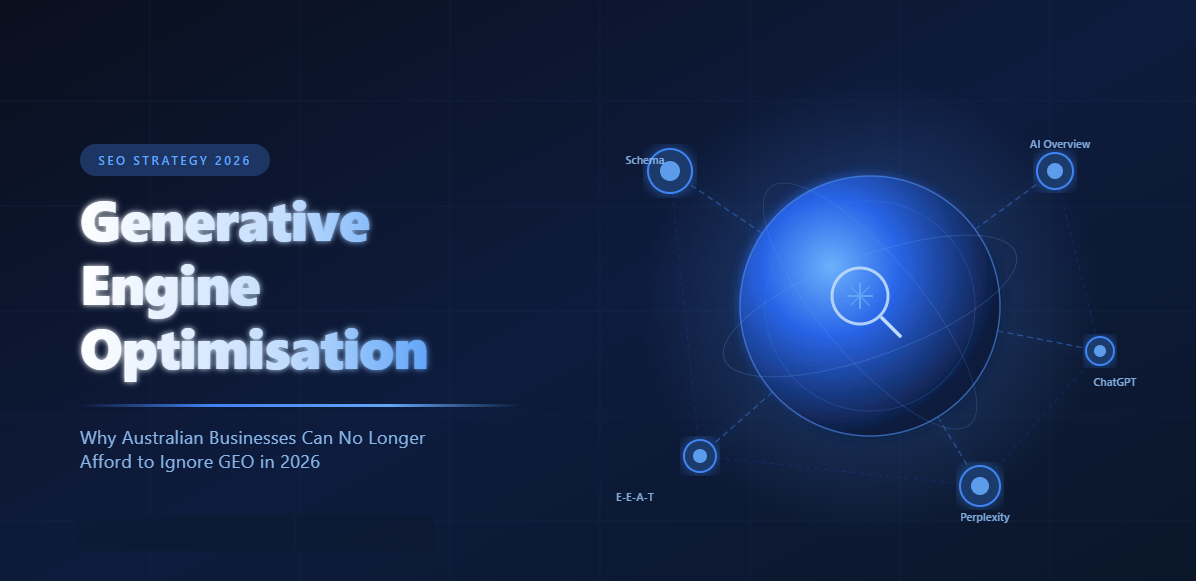
The search landscape has shifted beneath our feet, and for Australian businesses still anchored to 2023 strategies, the ground is moving faster than most realise. Google, ChatGPT, Perplexity, and a growing number of AI powered search tools are no longer simply returning a list of blue links. They are synthesising answers, forming opinions about your brand, and deciding whether your business is worth recommending before a single user even clicks through to your website.
Welcome to the era of Generative Engine Optimisation, or GEO.
If you have not yet heard this term spoken confidently in your marketing meetings, it is time to change that conversation. GEO is the discipline of ensuring your brand, content, and digital footprint are structured in a way that earns citations, recommendations, and favourable mentions inside AI generated search responses. It is, in many respects, the next evolution of everything SEO practitioners have spent the last decade building. And it is here now, not on the horizon.
What Has Actually Changed in Search
To appreciate why GEO demands attention, you first need to understand the fundamental shift in how people find information. Millions of Australians now open ChatGPT, Google AI Overviews, or Perplexity before they open a traditional search results page. They are not typing in three word keywords and scrolling through ten results. They are asking nuanced, conversational questions and expecting a synthesised, intelligent answer.
When someone in Melbourne asks an AI tool, “Which digital agency should I trust for my eCommerce SEO?”, the AI does not run a keyword match. It draws on everything it has absorbed about your brand, your reviews, your content, your backlink profile, your thought leadership, and your reputation across the web. The businesses that have invested in genuine authority and consistent digital presence are the ones being recommended. Everyone else is invisible.
This is the new battleground, and it is far more holistic than traditional SEO ever was.
The Three Pillars of a Strong GEO Strategy
Understanding GEO conceptually is one thing. Executing it with precision is another. For Australian businesses and the agencies serving them, success in generative search comes down to three core pillars.
Authoritative, Experience Driven Content
AI systems are extraordinarily good at distinguishing between content written by genuine experts and content manufactured purely for rankings. Google’s E-E-A-T framework (Experience, Expertise, Authoritativeness, and Trustworthiness) has never been more relevant. In 2026, your content must demonstrate lived experience and original perspective. Case studies grounded in real client outcomes, proprietary data from your own research, and insights that cannot be replicated by an AI writing tool are the assets that will earn citations from generative engines.
A practical starting point: audit your existing content library and identify every piece that relies on generic industry information rather than original insight. That content is not helping you in the new search environment. Prioritise refreshing it with data, real examples, and named expert perspectives.
Brand Presence Across the Entire Ecosystem
Generative AI does not confine its knowledge gathering to your website. It ingests Reddit threads, industry publications, review platforms, social media discussions, news articles, and forum conversations. What the broader internet says about your brand shapes how AI systems perceive and recommend you. If your brand is largely absent from these conversations, or worse, only present when something goes wrong, you have a significant GEO problem.
Australian businesses need a deliberate brand omnipresence strategy. This means securing features in trusted industry publications, encouraging authentic customer reviews across multiple platforms, building relationships with journalists and content creators in your sector, and contributing meaningfully to online communities where your audience gathers. Each of these touchpoints becomes a data signal that AI systems use to evaluate your credibility.
Technical Structure That Machines Can Read Instantly
Structured data and schema markup have existed for years, but their importance has multiplied considerably now that AI systems are the primary audience parsing your pages. Implementing schema at an advanced level, including nested schema types that connect your content to known entities, author authority signals, and clearly defined topical hierarchies, gives generative engines the context they need to trust and cite your content.
Additionally, the way you structure your written content matters enormously. Leading with direct answers, using clear logical hierarchies, and front loading the most important information at the top of each section all increase the likelihood that your content is selected as a source within an AI generated response.
Why Australian Agencies Must Lead This Conversation
Here is an uncomfortable truth for the local market. Many Australian businesses are still waiting for permission to take GEO seriously. They are watching international competitors build genuine AI visibility while continuing to invest exclusively in traditional keyword rankings. The gap is widening every quarter.
The businesses that will dominate Australian search in 2026 and beyond will be those that treat GEO not as a replacement for SEO, but as its necessary and urgent expansion. Traditional search fundamentals, including technical site health, backlink authority, and on page optimisation, remain foundational. Nothing about GEO renders those efforts obsolete. What GEO does is extend the playing field into territory that most local businesses have not yet entered.
For SEO agencies, this creates an exceptional opportunity to add measurable, differentiated value to client relationships. Agencies that can audit AI visibility, design brand omnipresence programmes, and structure content for generative citation are positioning themselves as genuine strategic partners rather than simply ranking service providers.
The Practical Step You Can Take This Week
You do not need to overhaul your entire strategy overnight. Start with a single, highly specific question: does your brand appear in AI generated answers when a potential customer asks about the problems you solve?
Open ChatGPT, Perplexity, and Google AI Overviews. Type in the questions your ideal customer would ask. See whether your business is mentioned, cited, or recommended. If it is not, you now have a clear and compelling brief for what your SEO and GEO strategy needs to prioritise next.
The search engines have changed. The businesses that adapt now will set the standard that everyone else scrambles to follow.